



The bull purchase is unlike any other decision that gets made by a cow-calf operation. It carries enormous importance to the success of a herd. The average bull will have a far larger genetic footprint than even the most productive cows, siring well over 100 calves over the course of his time in a herd. The genetics that we bring into our herds have impacts not only on the immediate calf crops that a bull sires but also on the daughters that we potentially retain as replacements.

Despite the importance, we assume a fair amount of risk when we go out and purchase a bull. Particularly in bull markets like the one we’re in right now, we are making a considerable investment in an animal that has never bred a cow. A variety of developments in the past 50 years have focused on mitigating the risk of investing in the wrong bull for our herd’s selection goals.
An expanded toolkit
Today, breeders have more information at their disposal than ever before to help make selection decisions. This evolution in genetic information has occurred rapidly in the grand scheme of things. After centuries of selection based solely on visual appraisal, performance recording programs began only in the 1950s. These programs paved the way for the calculation of expected progeny differences (EPDs) in the 1970s. EPDs use statistical methods to predict an animal’s genetic potential based on pedigree information and performance records. Other developments, including the introduction of genomics into calculations, have improved the predictive ability of EPDs.
Since they came on the scene a little over 50 years ago, the number of traits we have EPDs for has increased enormously. The American Angus Association now reports EPDs for more than 25 traits, from Calving Ease to Carcass Weight to Cow Longevity and everything in between. Other breed associations have seen similar increases in their suites of selection tools. This is all in an effort to capture the genetic potential for all the traits that affect an operation’s profitability. While this expansion of our selection toolkit is unequivocally a good thing, it can cause information overload when it comes time to make a bull purchase. Trying to sift through 20 numbers that have different units that aren’t interpretable between breeds can cloud this vital decision.
To help reduce the complexity of this decision, genetic evaluations calculate a handful of economic selection indexes that distill multiple EPD values into a single number, which can be interpreted as genetic potential for profit in a given breeding scenario. This allows weights to be placed onto traits in an economically optimal manner. For example, a maternal index designed for a herd that retains replacement females and markets calves at weaning would place heavier economic weights on Cow Longevity and Weaning Weight, and no emphasis on Marbling or Ribeye Area. For commercial producers, indexes are a great way to distill many traits into the one trait that really matters: profit!
Understanding the human side of selection decisions
While this sounds like the selection decision should be pretty cut and dried, the bull selection decision is anything but. Every operation has slightly different breeding objectives and budgets. Layer on over 20 types of EPDs, plus a visual evaluation, plus the added stress of an auction, and it is easy to see how buyers could make suboptimal decisions. That is to say: There is a clear human side to all of this.
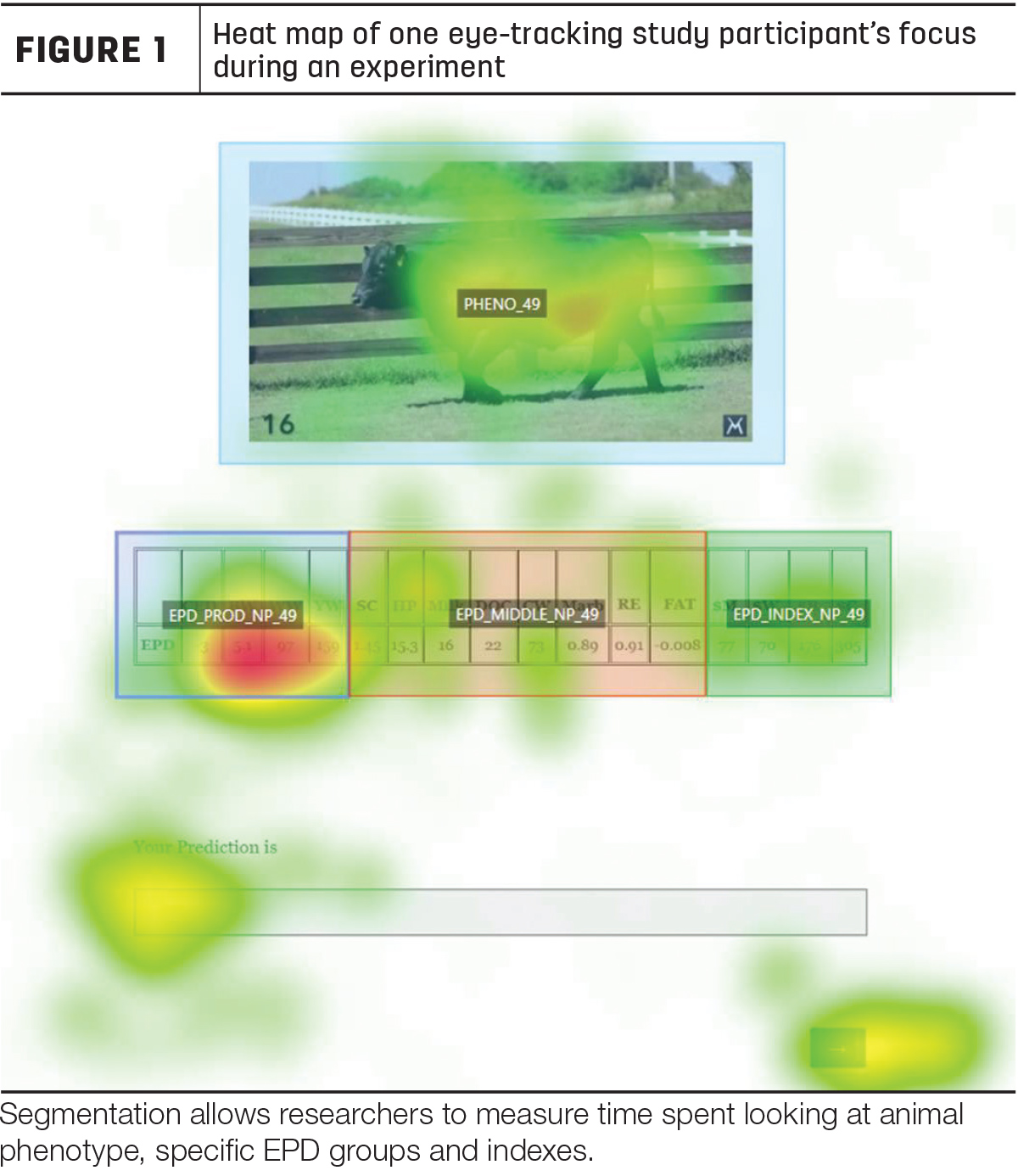
Over the past five years, we have been working to understand how producers actually use different sources of information in making bull-buying decisions. To do this, we use eye-tracking technology, an approach that has been deployed to understand consumer preferences from the grocery store to Disney World. We set up experiments in a “virtual” bull sale, where participants are given varying amounts and types of information, such as EPDs, indexes, animal videos and genomic data. We then ask producers to rank bulls or predict their prices. Over multiple experiments and hundreds of participants, these are some of the most important things we have uncovered:
- EPDs help level the information playing field. In behavioral economics, there is a well-known phenomenon called optimism bias. Essentially, sellers tend to overestimate the value of what they are selling, while buyers do just the opposite. We find that without EPD information, the gap between buyer and seller valuations of bulls is quite large: Sellers grossly overestimate, while buyers underestimate. When we add index and EPD information, this gap effectively disappears, indicating that this information helps level the playing field and create a more efficient marketplace where buyers and sellers are on the same page.
- How we present information matters. In another experiment, we altered how we present EPDs and indexes, simply flipping the order so that indexes appeared before the traditional performance traits that buyers may be more familiar with. We saw that when buyers received the “flipped” selection tools, their price predictions and ability to rank animals correctly increased.
- Buyers use the information they understand. Our eye-tracking technology also allows us to quantify where and for how long participants interact with specific areas. We find that newer EPDs and indexes get less fixation time, even if they are essential for helping a buyer rank a bull or predict its price. We can also see how participants visually appraise bulls. Time spent evaluating specific EPDs aligns with presurvey levels of understanding of these values.
Putting behavioral information to use
This work has shed light on several areas where we can improve information delivery and educational efforts to help commercial buyers put genetic information to its best use. There are a couple of things that we think are particularly important:
- Remember that less is more and presentation matters. The breadth of our genetic selection toolkit is invaluable to improving the profitability of animals across our industry. That said, presenting all this information can be overwhelming, and often buyers use only a small fraction of what is delivered. Altering how we present information can help direct commercial customers to the most relevant pieces of information. Directing buyers toward selection indexes and other important individual EPDs can help narrow focus and reduce information overload, leading to better investments.
- Target educational efforts. This work is useful in helping extension professionals, breed associations and seedstock producers target their education efforts around selection tools that should be on commercial customers’ radars. In Tennessee, we have responded to these findings by focusing additional educational programming on educating commercial producers on selection indexes. Sellers can also do this in their presale communications, footnotes or personal conversations with buyers.