
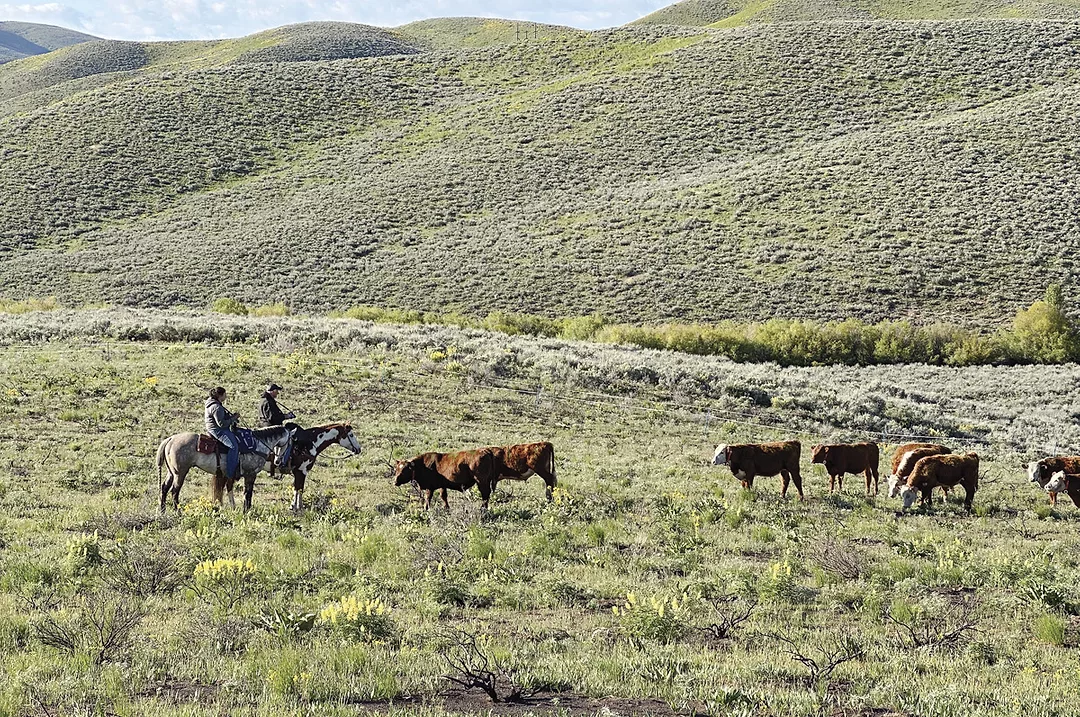
Resting a pasture for two growing seasons postburn is a common recommendation in the Intermountain West since at least the ’80s. “The question is, ‘Is there a real reason two full years rest are needed after fire?’” says University of Idaho (U of I) area extension range educator K. Scott Jensen. “Can it occur sooner than that without delay or harm to postfire recovery? We wanted to put some science to it.”

“There’s no national policy that requires that, but it’s pretty much the common practice,” says U of I professor and extension beef specialist Dr. Jim Sprinkle. With frequent and large wildfires becoming the new norm in much of the western U.S., many ranchers have felt the squeeze to provide supplementary forage during such rest times. Land managers also express concern that an extended rest may favor undesirable grasses like cheatgrass, which flourish (and outcompete desired native species) under a short fire cycle.
So when in September 2024 the Glendale Fire burned over 7,500 acres of public and private rangeland west of Hailey, including a portion of U of I’s Rinker Rock Creek Ranch (RRCR), researchers saw an opportunity to measure impacts of grazing on the ranch the following year.
“There has been some research, but not a lot of well-replicated research,” says Sprinkle, who was the lead investigator on the RRCR study. “There is some research out there but it has not been advertised as much as you’d hope.”
Study design
With funding from the David Little Range Livestock Endowment, researchers used electric fencing to block out four 44-acre pastures. Beginning in mid-May, 14 collared Hereford steers were rotated through the pastures, spending two weeks in each. They finished grazing the final pasture in mid-July. “Eight months after the fire would be the time it would be perceived to be most at risk,” says Sprinkle of the selected timing.
Just before scheduled turnout, researchers clipped samples to determine forage availability, which was perhaps one-third of what would be expected in a nonburned area. They set a stocking rate accordingly, aiming for 30% utilization (and achieving 24%, on average).
Data collection occurred in all four pastures and four corresponding nongrazed “control” plots in 2025. Researchers also have some prefire standard monitoring data, for a baseline. “We really would like to follow through for three seasons, but that is funding-dependent,” says Jensen.
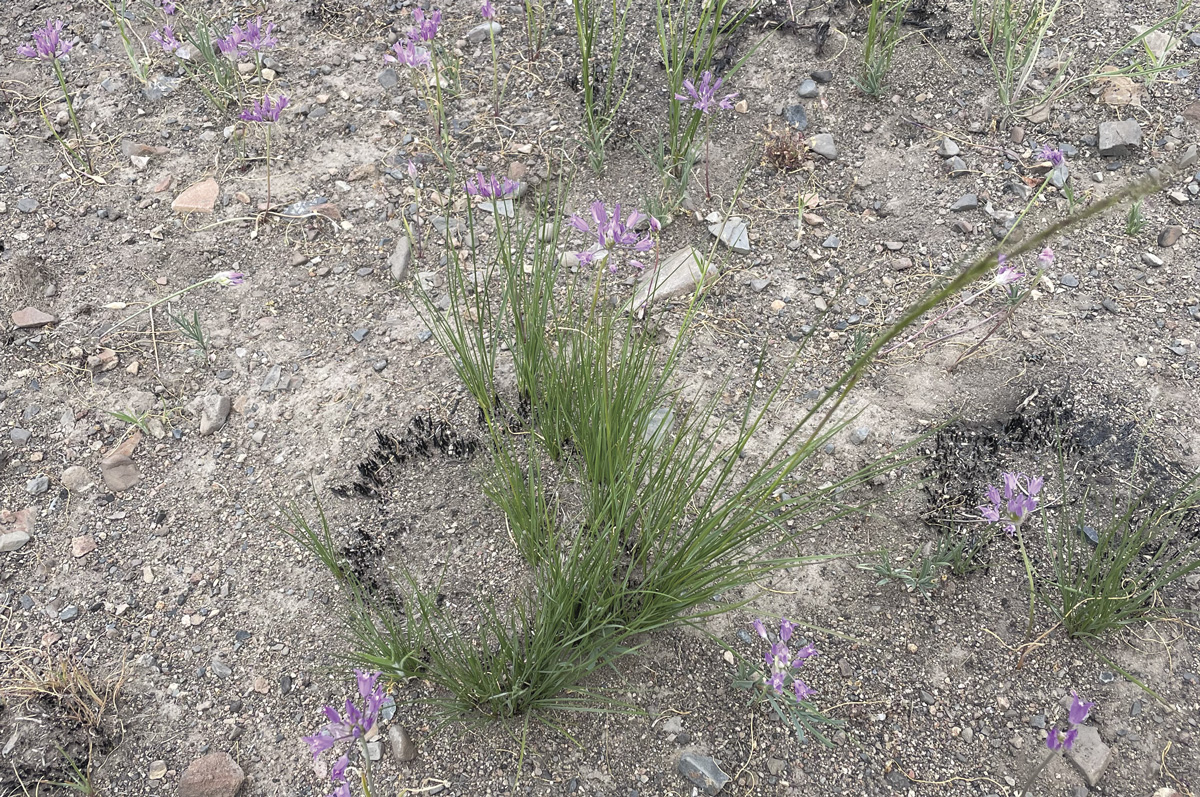
Burned portions of U of I’s Rinker Rock Creek Ranch were heavy on bare ground the spring following the Glendale Fire, but some native bunchgrasses survived. Image by Jim Sprinkle.
Preliminary results: Grazing and fire
Based on location and acceleration data gleaned from GPS collars, steers “wandered” more than usual as they grazed, presumably due to limited forage. However, gains were still acceptable at 2.34 pounds per day.
“They preferred some of those grassy sloughs where grass was more abundant,” says Sprinkle, adding that these areas tended to be burned less severely. However, steers used about 90% of the area in each of the first three pastures, with challenging terrain limiting use of the rest.
In the last pasture, grazed between June 30 and July 14, steers only used about 64% of the pasture, as rising summer temperatures decreased their willingness to graze less hospitable ground. “In areas with less vegetation and more rock, it was hotter,” says Sprinkle.
Cheatgrass consumption was also tied to timing and temperature. In the first two pastures, grazing reduced cheatgrass. In the third, cheatgrass increased in the control but remained constant in the grazed treatment. In the fourth pasture, cheatgrass increased in both treatments. “I didn’t expect to see that effect of spring grazing on cheatgrass,” says Sprinkle. “I would expect to see it with fall grazing.”
With cheatgrass management being a point in favor of early postfire grazing in infested areas, researchers are also concerned about impact on native perennials as they continue to sift through the monitoring data. “We haven’t seen anything to indicate that we harmed anything by grazing after fire, but we are continuing to look at that,” Sprinkle says.
Preliminary results: Seeding
Reseeded areas can be particularly sensitive to damage by grazers. “After the fire, which burned roughly 20 percent of the ranch, we decided to do as much seeding as we could,” says RRCR operations manager Cameron Weskamp. Based on prefire plant community composition, research focuses and wildlife use, researchers broadcast a mix of native grasses (bluebunch wheatgrass, basin wild rye, bottlebrush squirreltail and Sandberg bluegrass) and forbs (yarrow and penstemon).
“It was probably a subset of what is seeded on BLM,” says Weskamp. On a limited budget, they chose to exclude some of the more expensive seeds, particularly forbs, in favor of seeding more acres. Seed availability also limited options, as the Glendale fire burned toward the end of a particularly busy fire season.
“We had to work really fast,” says Weskamp of finding funding, sourcing seed and preparing a plan. A grass and forb seed mix was broadcast over 890 acres via fixed-wing aircraft in early November, before snowfall. Sagebrush seed and plugs were put out the following year.
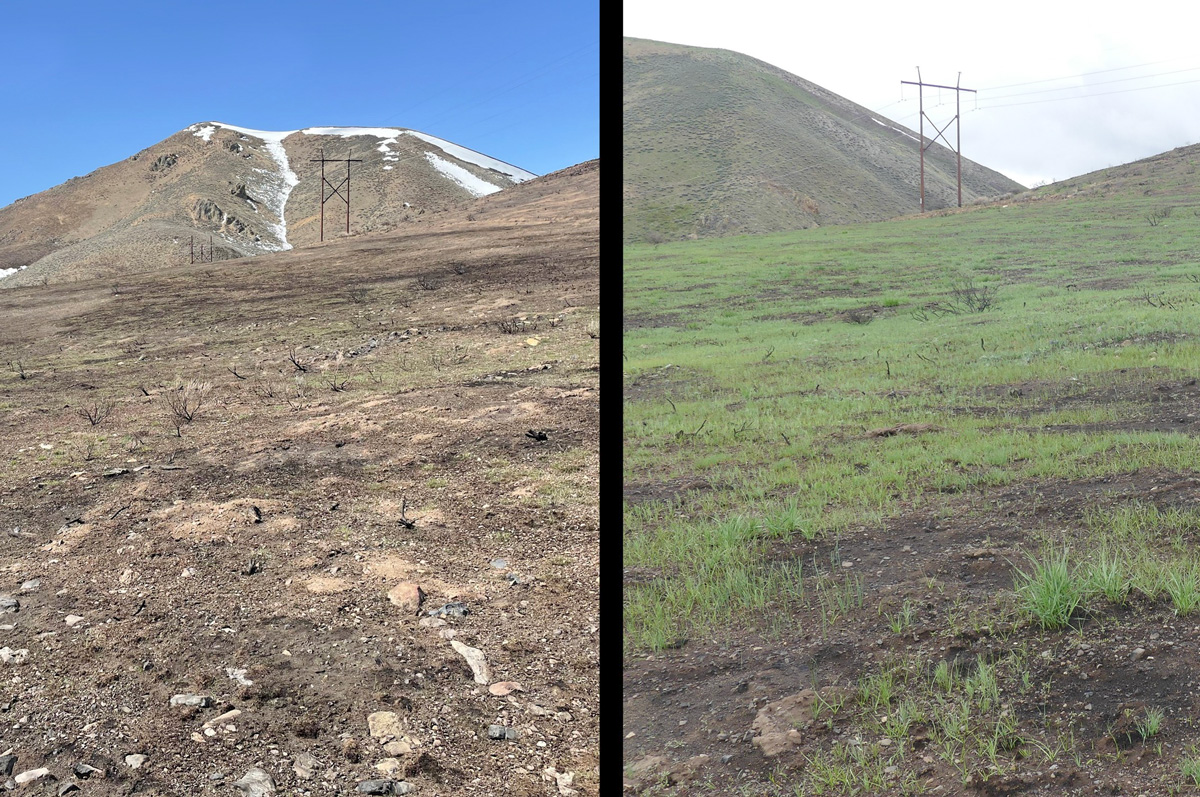
This is one of the four experimental pastures at U of I’s Rinker Rock Creek Ranch, seven and eight months postfire. Grazing commenced in this pasture on June 2, 2025. Images by Jim Sprinkle.
“Three of the four pastures were either seeded or had a seeded portion,” says Sprinkle. Across the ranch, managers prioritized areas with a high chance of recovery but also high need. Erosion-prone slopes, high cheatgrass infestation and burn severity were some of the factors considered.
Researchers were pleased to note good native perennial grass establishment across the board. “We don’t have exact stats on germination,” says Weskamp. “Some of Jim’s results will get at some of that. … But it’s also hard to know because there is a native seedbank.”
Root stability was of particular interest. One metric of note was number of “failures,” or plants entirely uprooted. Sixty-four percent of these occurred in the shallow-rooted pioneering species oniongrass (which was recruited from the native seedbank) and relatively few in the other perennial native grasses.
Application
“This wouldn’t be just a blanket thing,” says Jensen of the appropriateness of grazing so soon after fire. Site-specific context – including climate, preexisting plant community, burn severity and goals – need to drive decision-making.
Further, says Jensen, “It really would depend on the producer or manager, on what they’re willing to do. It would require time in the saddle or fencing. What I really think would make it more doable on a larger scale would involve the use of virtual fencing” – a technology which has seen success in several projects around the state involving researchers, ranchers and federal land management personnel.
But Sprinkle hopes proactive land managers will take note of the study’s results when designing a postburn plan. “I don’t think we’re doing things a great service by excluding grazing after fire,” he says. “There are areas of south Idaho where permittees haven’t been allowed to graze their allotments for six or seven years. We’ve got to do something different. We’re losing a tool in our toolbox.”
Grass species included in the RRCR seed mix
- Bottlebrush squirreltail
- Great Basin wild rye
- Sandberg bluegrass
- Bluebunch wheatgrass
Forb species
- Yarrow
- Penstemon