


Ask most dairy producers about lameness prevalence in their herd, and the answer is usually 5% to 10%. While sincere, this figure only represents the tip of the proverbial lameness iceberg.

The number typically only reflects the clearly lame cows, the ones that stand out. But what’s visible is only part of the picture. The mildly lame cows, or those just starting to decline, often go unnoticed. This hidden group is where the real losses begin to accumulate, especially when it comes to reproduction.
The cost of mild lameness on fertility
Lameness is often discussed in terms of treatment, hoof trimming or lost milk production. Yet 30% to 40% of its total cost is tied to fertility.
That’s because lameness is not just a foot or hoof issue; it affects the whole animal. And when it comes to reproduction, small changes in behavior and physiology have measurable consequences.
A cow that is uncomfortable behaves differently, and heat expression is generally more difficult to detect because she walks less, mounts less and is less willing to stand to be mounted.
For herds relying on heat detection, whether visual or through activity monitoring, this poses a clear challenge. If a cow does not show heat, she is unlikely to be bred. If she is not bred, days open increase, which costs on average $2 to $6 per cow per day.
But the impact of lameness goes beyond missed heats.
Lameness casts a wide net
Even in herds using timed A.I. protocols, where heat detection is less important, lameness still affects a cascade of fertility outcomes.
Lame cows are more likely to experience uterine infections postpartum, face greater negative energy balance, are less likely to resume ovarian cyclicity during the transition period and have lower conception rates with higher pregnancy loss.
For instance:
- Lame cows typically have lower feed intake.
- Lower feed intake can push cows into negative energy balance, particularly in early lactation.
- Negative energy balance is closely linked to poorer oocyte quality.
- Lower-quality oocytes reduce the likelihood of successful fertilization and embryo development.
So even when a lame cow is inseminated on schedule, her chances of becoming pregnant are lower. This is where mild lameness becomes costly. These cows may still be mobile, still producing and still entering the breeding program, but they underperform in ways that are easy to miss.
Data show cows with only mild mobility issues at the time of insemination can have conception rates up to 10% lower than cows with sound locomotion. In reproductive terms, that is a significant gap.
Earlier signals = Better insight
Lameness rarely appears overnight. It develops gradually, with subtle changes in gait and posture before a cow is visibly lame.
Traditional mobility scoring depends on human observation. While valuable, it is typically done infrequently and captures a single moment in time. However, that approach makes it difficult to detect early-stage issues or track gradual decline.
Continuous monitoring helps close that gap. By observing cows daily using artificial intelligence, it is possible to establish a baseline for each animal and identify small deviations from normal movement. A cow that moved well last week but is now slightly less consistent can be flagged early.
This shifts the focus of protocols and interventions. The goal is not to identify cows that are already lame but to detect cows that are becoming lame before issues escalate.
Timing drives improved outcomes
Detection alone does not solve the problem. The value lies in how quickly action follows. When lameness is identified early, intervention can happen sooner, whether that involves hoof trimming, treatment or management changes.
Timing has a measurable impact. Field data show that cows treated shortly after detection recover significantly faster than those treated weeks later. In some cases, the difference in recovery time can be as much as 40 days. That time frame corresponds to roughly two heat cycles, potentially affecting reproductive performance.
Figure 1 features data from more than 9 million locomotion scores collected from 25,000 cows across more than 20 farms.
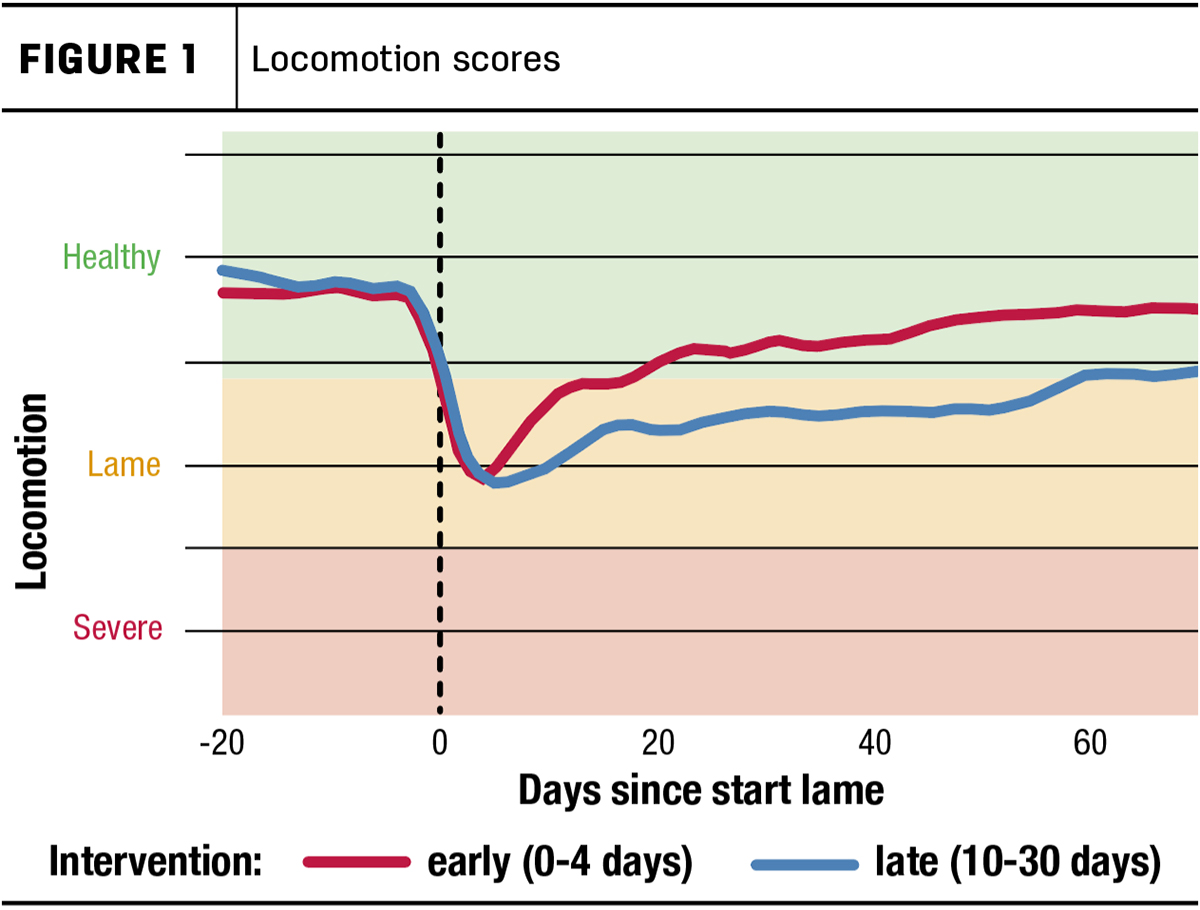
Less time spent lame leads to:
- More consistent feed intake
- Improved energy balance
- Stronger estrus expression
- Higher likelihood of conception
It also reduces the risk of cows becoming chronic cases – those that never fully recover continue to affect herd performance and become leading candidates for a career change.
Connecting mobility to reproduction
Ultimately, managing lameness earlier and more consistently directly supports reproductive performance. Cows with good mobility maintain more stable feed intake and body condition. They cycle more regularly, express heat more clearly and respond better to breeding programs.
Over time, this leads to improved conception rates, fewer days open and a more efficient herd.
Lameness cannot be fully eliminated, but its impact can be reduced. Housing, nutrition and environmental conditions will always play a role – what producers can control is how quickly lameness is identified and addressed.
For producers focused on reproductive performance, the takeaway is simple: Act sooner. By the time lameness is obvious, its effects on fertility are already in motion. Early detection is not just about mobility. It’s a direct lever to protect reproductive success.